Learning Activities
- Recognition (辨識)
- Face recognition
- Voice recognition
- Character recognition
- Association (聯想)
- Induction (推論): Reinforcement learning
- 如何在俄羅斯方塊得高分?
- 如何在圍棋比賽贏得對方?
 Biological Neural Networks
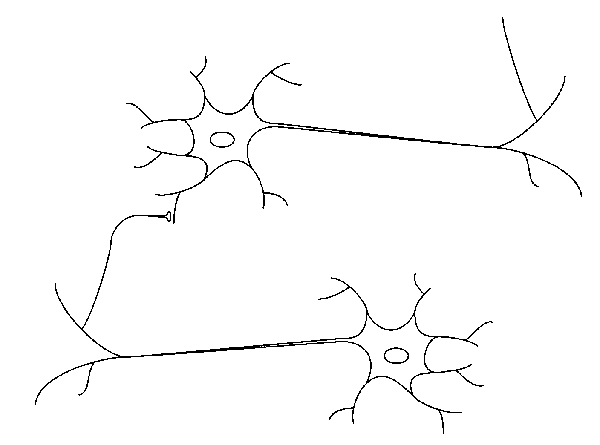
- A human consists of approximately 10^11 neurons, each with
approximate 10^4 connections to other neurons.
- Each neuron has three principal components:
- Cell body
- Dentrites
- Axon
- Neural structures continue to change throughout life.
- Though biological neurons are very slow when compared to
electrical circuits (10^-3 S compared to 10^-9 S), the brain is able to
perform many tasks much faster than an conventional computers.
Artificial Neural Networks
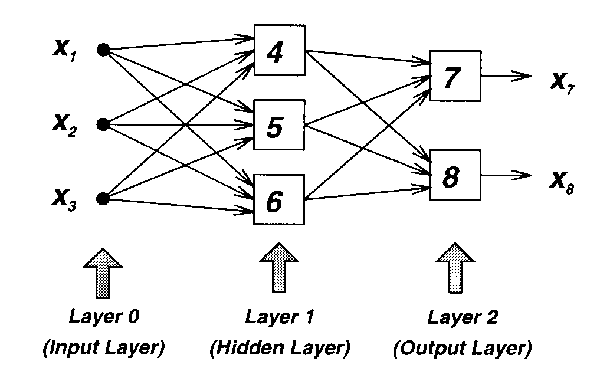
- Properties of NNs:
- Simple processing units (neurons)
- Parallel processing
- Distributed learning
- Fault tolerance
- Classification:
- Supervised learning:
- Single layer perceptrons
- Multilayer perceptrons (MLPs)
- Radial basis function networks (RBFNs)
- Modular neural networks
- Learning vector quantization (LVQ)
- Unsupervised learning:
- Competitive learning networks
- Kohonen self-organizing networks
- Adaptive resonant theory (ART)
- Others:
This page is maintained by
Jyh-Shing Roger Jang.
Comments and suggestions are welcome:
jang@cs.nthu.edu.tw.